Tag: melancholy

  • Review of The Last One For The Road: funny and melancholy journey

    Featured image Review of The Last One For The Road funny and melancholy journey

    This wistful Venetian road movie takes two aging drinkers and a shy student on a chaotic search for one last drink, finding unexpected humour and profound beauty in their pursuit.

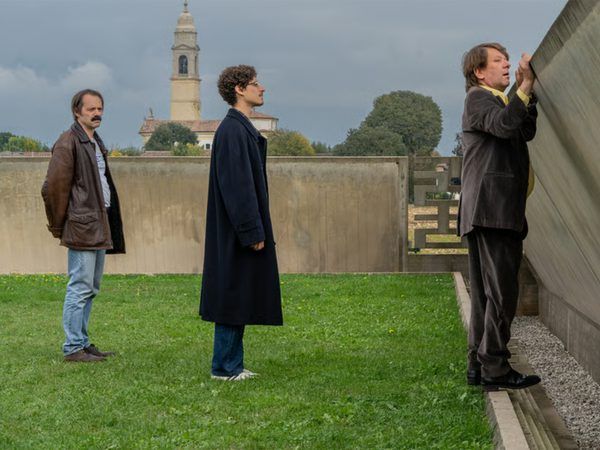
    The film introduces Carlobianchi and Doriano, two men who embody the wisdom of the open road. As they drift across the barren outskirts of Venice, they treat irresponsibility not as a failing but as a philosophy, viewing drunkenness as a guiding principle. These charming figures are steeped in a kind of tragic charm; they perform youthful swagger deep into middle age, offering a wry perspective on life’s inevitable wandering while subtly hinting at underlying melancholy. Their mantra, “There’s never another time,” serves both as an irresistible invitation and a gentle warning.

    Their journey is soon complicated by the arrival of Giulio, a young architecture student grappling with his academic reviews. He becomes caught up in the chaotic rhythm created by the older drinkers, whose stories and their pursuit of freedom gradually eclipse his structured life. As the group navigates the labyrinthine streets, Giulio’s transformation unfolds—a sweet loosening-up fueled by connection and shared experience.

    The visual aesthetic is deeply atmospheric, drawing tactile affection for the aged architecture and the bruised beauty of the Venetian setting. The landscape itself becomes a character, amplifying the film’s thematic richness. This sense of place shines through in humorous moments, such as a scene where the trio pose mock-architects at a count’s villa, highlighting the absurdity found within grand settings.

    While Giulio’s gradual softening is endearing, the depth of his bond with the older men sometimes feels assumed rather than fully earned. Yet, the film ultimately succeeds in finding an unsteady tenderness in lives lived without strict adherence to convention, offering a poignant yet deeply felt glimpse into the complexity of human existence. It is a celebration of imperfect lives, delivered with both laughter and lingering sadness.

  • Blue Heron review – wonderful, emotionally generous film

    In the landscape of Canadian independent cinema, some films don’t just tell a story; they invite you to inhabit a feeling. Sophy Romvari’s debut feature film, Blue Heron, is precisely one of those cinematic invitations—a sun-bleached, deeply textured portrait of a family navigating the turbulent waters of new life.

    The movie pulls back the veil on a dysfunctional family of six who have recently migrated from Hungary. Told through hazy pre-millennial memories, Blue Heron functions less as traditional narrative and more as a collection of fragmented, shimmering recollections—a visual journey steeped in nostalgia and delicate melancholy.

    The lens focuses on Troubled teen Jeremy, the youngest of the group, whose perspective guides the film. He is the silent observer watching his world shift around him, grappling with the complex dynamics of his family. The title itself references a bird that seems to grow increasingly distant from its offspring, mirroring the emotional distance within the family unit.

    The core tension lies in the struggle for control. Jeremy’s behavior swings between playful and destructive, creating an atmosphere thick with unresolved tension. As the parents attempt to navigate these complexities, they grapple with a challenging reality: they are unable to offer clear solutions, yet they recognize the signs of oppositional defiant disorder, a pattern of anger that defines their environment.

    Romvari layers this emotional landscape with cinematic experimentation. The film moves beyond simple documentation, dipping into narrative shifts and visual flourishes reminiscent of more avant-garde storytelling. A sequence involving an older version of a family member introduces a reflective, almost ethereal opening, using hand-drawn maps and an omniscient perspective to frame the memory.

    This meticulous attention to sensory detail—the shimmering light, the ghostly sketches—transforms the personal history into something larger than autobiography. Blue Heron challenges easy categorization, refusing simple answers while deeply exploring a profound proposition: that our personal histories are not linear facts, but rather collections of incomplete dreams.

    It is a film that resists definitive labels, offering instead an experience that asks the viewer to sit with their own memories, to explore the texture and complexity woven into the fabric of the past. It reminds us that sometimes, the most powerful truths are found in the hazy, beautiful spaces between what we remember and what we live.

    Buy on Amazon