Giant’s Eye Cinema’s Visual Paradox
The Geometry of Giants: How Christopher Nolan Solved the Cyclops Conundrum
For over a century, cinema has wrestled with the challenge of creating believable monsters. But when it comes to the Cyclops—the one-eyed giant archetype—the quest for perfection has been notoriously difficult. Then came Christopher Nolan, who didn’t just find an answer; he made the impossible feel undeniably real, turning a classic mythological figure into something visceral and unforgettable.
Nolan’s film The Odyssey is already a technical marvel, boasting everything from a massive Viking ship replica to being shot entirely on IMAX. Yet, his most profound filmmaking feat lies in making the Polyphemus feel genuinely alive. The difficulty isn’t just about rendering scale; it’s about achieving anatomical believability. Most attempts at the one-eyed giant quickly succumbed to the uncanny valley, tumbling out of the cave rather than emerging as a formidable entity.
Before Nolan stepped in, cinema had produced a graveyard of Cyclopes that often felt less mythological and more gimmicky. From poorly rendered designs in adaptations of Percy Jackson to plasticine-faced flops like Krull, many efforts struggled with the fundamental challenge: making the monster psychologically real.
Even large-budget attempts, such as Wrath of the Titans, faced technical hurdles. Visual effects experts found that forcing a human face onto an inhuman creature proved problematic. As Mark Wilson, a lead from Framestore, noted during development for one project, merging eyes proved challenging because human eyes don’t operate as singular entities.
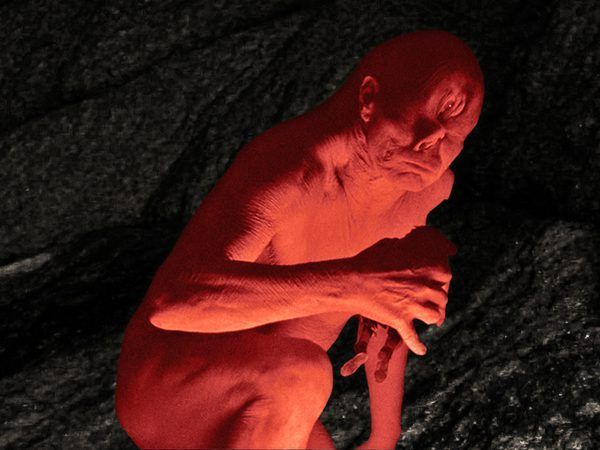
The key to unlocking the Cyclops’ believability wasn’t simply better CGI; it was rethinking the design itself. Instead of trying to force a familiar human structure onto the monster, Nolan chose a radical, yet brilliant, approach: turning the entire face sideways. This deceptively simple modification allowed the Polyphemus to benefit from its immense scale and created an unsettling, organic quality that audiences instantly accepted.
This sideways design brilliantly solved the issue of realism. Professor Debbie Felton argues that by mimicking features found in real anatomical abnormalities, such as cyclopia—a deformed nose—Nolan’s design felt more tangible and organic than previous attempts. It made the creature look less like a costume piece and more like an inevitable physical reality.
The genius of the solution is further amplified by integrating practical artistry with digital effects. Nolan didn’t just rely on screens; he used talent. Actor Bill Irwin, who provided both the likeness and voice for Polyphemus, was central to this process. He acted as the living embodiment of the giant. Furthermore, Nolan gave Irwin props—including semi-edible men with internal skeletons—allowing him to interact with the creature in a physically tangible way.
This practical approach echoes earlier cinematic mastery. The tactile nature achieved by stop-motion artists like Ray Harryhausen in films such as The 7th Voyage of Sinbad steered their monsters away from the uncanny valley, proving that physical presence often trumps pure digital trickery.
Ultimately, Nolan’s approach was a masterclass in practical problem-solving. He understood that to create a truly compelling monster, one doesn’t need endless digital manipulation. The Cyclops solution was surprisingly simple: give him a voice, make him tangible, and when designing his face, simply turn the problem on its side. It is this fusion of art, anatomy, and performance that elevates the giant from spectacle to soul.
Buy on Amazon
Credit