Lost Y2K Japanese horror hybrids
At the turn of the millennium, Japan was simmering with a cinematic energy that would eventually explode onto the global stage. Amidst this creative fever, a figure named Takashige Ichise navigated the often-unruly side of the Y2K horror boom, producing films that often slipped beneath the mainstream spotlight.
Ichise’s influence is deeply woven into the fabric of Japanese horror history, with production credits spanning major hits like Ring (1998), Dark Water (2002), and the Ju-on films (2000-), as well as Hollywood remakes such as The Grudge (2004-).
When entering the industry in the 1980s, Ichise noted that there was little market for Japanese horror. He had initially planned to adapt the novel Ring, but the funding companies deemed such projects too risky. Yet, by the end of the century, the landscape had dramatically shifted. The success of films like Hideo Nakata’s Don’t Look Up and Kiyoshi Kurosawa’s Cure in the mid-90s signaled a new potential. This momentum allowed Ichise to pivot, doubling down on the genre by spinning successful hits into franchises while simultaneously experimenting with the genre’s core talent pool to “expand boundaries.”
As domestic successes generated blockbuster remakes in the States, the discomfiting originals found new audiences across Europe via specialist distributors and late-night transmissions. Audiences were already hungry for something sinister beyond Hollywood slashers, gravitating instead toward atmospheric indie works like The Blair Witch Project (1999).
Today, the celebrated ‘J-Horror’ lineage is defined by low-budget, psychological works featuring muted colors, long-haired ghosts, and a dose of techno-paranoia. But the true story lies in the countless experimental productions made by core talents that failed to achieve the same overseas impact.
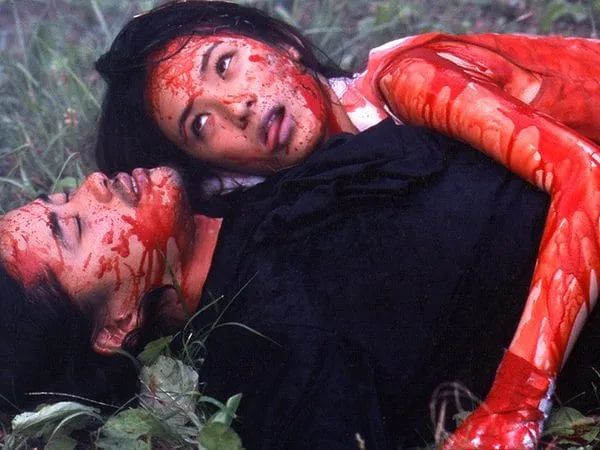
This is where films like Crazy Lips and Gore From Outer Space carve out their own niche. Crazy Lips, produced by Ichise alongside Audition production company Omega Project, brought together talents from the J-Horror sphere. It featured a script by screenwriter Hiroshi Takahashi, known for embedding an uncanny quality into his screenplays, and connected actors like Hitomi Miwa from Ju-on: The Curse (2000) with composer Gary Ashiya from Cure.
Director Hirohisa Sasaki, who helmed the film, sought inspiration not from the folk-y curses of classic J-Horror, but from the erotic, grotesque, and absurd ghost stories of the 1960s, including those from studios like Shintoho and Okura Film. The resulting hybrid was a wild mix: spooky shots of decapitated schoolgirls mixed with gratuitous sex scenes, eccentric characters, and a maximalist martial arts climax. Ichise himself later likened the script to Peter Jackson’s Braindead.
The project faced hurdles attempting to find an international market. While it found a successful run as a midnight movie in Japan, the film struggled internationally because its strong emphasis on eroticism and action was deemed too provocative by distributors. One particularly graphic scene proved difficult to edit for overseas markets.
Despite these commercial setbacks, these absurdist horror-hybrids proved resilient. Films like Ryuhei Kitamura’s Versus (2000) and Takashi Miike’s The Happiness of the Katakuris (2001) managed to cross over, becoming cornerstones of collections like the Tartan Asia Extreme set in the UK.
Ultimately, these films demonstrated Ichise’s unwavering belief in the genre as a low-risk arena for experimentation. While the overall J-Horror boom subsided, these forgotten hybrids are now finding a new home. With recent collections and guides making foundational works more accessible, the strange and uneven lineage of the last great Japanese horror explosion is finally reaching a wider audience, proving that some cinematic experiments are destined for immortality.
If you are looking to explore this wider, more eccentric side of Japanese horror cinema, titles like Crazy Lips and
Buy on Amazon
- Ring
- Dark Water
- Ju-on
- The Grudge
- Don’t Look Up
- Cure
- The Blair Witch Project
- Crazy Lips
- Gore From Outer Space
- Audition
- Omega Project
- Ju-on: The Curse
- Versus
- The Happiness of the Katakuris
- Braindead
Credit