Messy Parade of Old Genre Gimmicks Reviewed
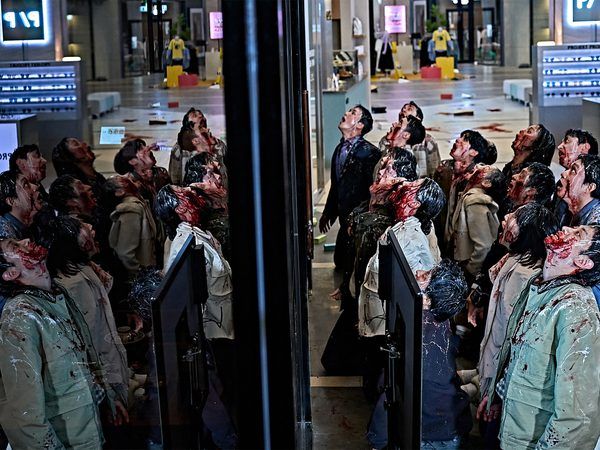
The zombie genre has evolved into a cinematic powerhouse, and few films stand as high-water marks as Yeon Sang-ho’s masterpiece, <Train to Busan>. That high-speed epic set against the backdrop of a relentless pandemic established an undeniable benchmark for action, gore, and emotional depth. Following this monumental success, expectations soared for the director’s next venture, <Colony>, a film promising to deliver the next generation of zombie horror. However, as <Colony> arrives, it finds itself navigating a tricky landscape—a world brimming with spectacle but ultimately stalled by familiar tropes and a gimmick that doesn’t quite ignite the fire.
The premise of <Colony> is undeniably potent. A deadly pathogen sweeps through a Seoul skyscraper, and the survivors—former spouses and colleagues—are thrust into a desperate fight for survival. The story centers on Professor Kwon and Professor Han, who must navigate a collapsing environment alongside others as the building becomes quarantined. The core tension lies not just in the presence of the flesh-eating zombies, but in the increasingly chaotic dynamics of the human survivors.
To elevate the narrative beyond simple survival, the film introduces a fascinating, albeit ultimately underdeveloped, concept: the zombies possess a shared consciousness. As the outbreak escalates, the dead begin to communicate, sharing knowledge through a collective trance. This “hive mind” mechanism is intended to inject a fresh layer of complexity into the horror, suggesting a unique, emergent behavior in the undead population.
Unfortunately, this intriguing gimmick struggles to sustain the narrative. While it offers moments of eerie visual spectacle, the focus remains heavily weighted on the mechanics of the communication rather than the nuanced emotional journey of the characters. The ensemble cast, including the survivors, often feels like a collection of archetypes rather than fully fleshed-out individuals. Protagonist Kwon, while central, lacks the depth needed to anchor a truly resonant story of disaster and survival.
The narrative pacing also struggles to keep pace with the build-up. Much of the two-hour runtime is spent reinforcing the repetitive lore of the hive mind, rather than driving forward the suspense or escalating the action sequences. Compared to the relentless kinetic energy of <Train to Busan>, the action in <Colony> feels noticeably scarce, leaving the audience waiting for the explosions and adrenaline that defined the previous hit.
When it comes to the visceral aspects of horror, the film shows flashes of genuine fright. The unsettling facial expressions and erratic movements of the zombies provide some of the few genuinely terrifying moments. Yet, this horror element is often overshadowed by a script that relies too heavily on predictable genre tropes. The film risks becoming a parade of established conventions, failing to deliver the suspense and emotional punch necessary to truly soar in the realm of epic horror.
Ultimately, <Colony> remains a film steeped in familiar zombie lore. While it attempts to reinvigorate the genre with its unique communication element, it falls short of its high expectations. It’s a visually engaging experience, but the lack of deep character arcs and a reliance on repetitive storytelling prevent it from being a revolutionary piece of filmmaking. It serves as a reminder that simply adding a clever concept isn’t enough; true horror relies on compelling characters and masterful execution.
Buy on Amazon
Credit