Nightborn: Bad visuals, bad story
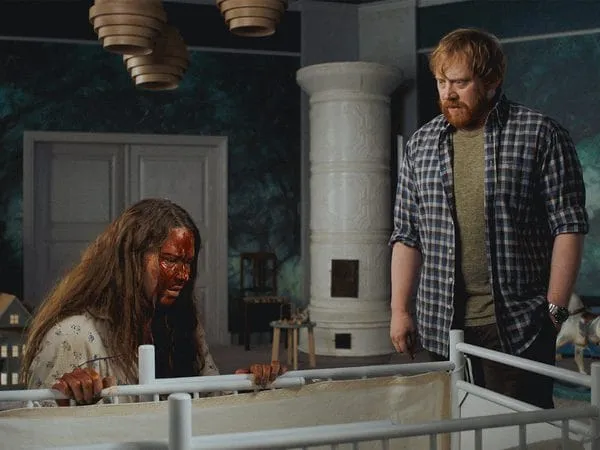
The dream of domestic bliss often shatters the moment a new life enters the picture. When a couple navigates the formative stages of a relationship, they often enjoy a cozy, romantic status quo. But when a child arrives, that comfortable reality quickly dissolves, replaced by an intense, often fractured, focus on protection and attention. Finnish filmmaker Hanna Bergholm taps into this profound tension in her maternal folk horror story, pushing the boundaries of reality with a chilling exploration of a couple’s attempt to nurture a nightmare child.
In Hatchling”>Hatchling, the narrative follows Saga (Seidi Haarla) and Jon (Rupert Grint), middle-class urbanites who seek refuge away from the city lights, choosing instead a secluded wilderness plot. They renovate a musty old house, clearing the mechanical detritus from the grounds, setting the stage for a seemingly idyllic domestic life. They craft a magical dream nursery, adorned with muslin drapes, vintage toys, and soft light, seeking a perfect environment for their child.
However, the reality of parenthood introduces a visceral shift. As the new life arrives, the shift in bodily chemistry and the sudden necessity of protecting this bundle of joy throw the couple into a psychological whirlwind. The film functions as a powerful, albeit unsettling, metaphor for post-partum psychosis, illustrating the intense struggle where Saga’s powerful maternal instinct battles the monstrous reality of her new child. She refuses to acknowledge the horror, even as her body screams in response, discovering that the only way to nourish the being is through raw red meat.
The film deliberately tosses logic to the wind, embracing absurdity as the central force. Bergholm uses this framework to explore the conflicts arising between Saga and Jon, their religious in-laws, their professional world, and the entire medical establishment. The narrative doesn’t just present a horror scenario; it exposes the breakdown of rational thought under extreme duress.
The performances are central to this unsettling experience. Haarla delivers an intense performance, embodying a maternal instinct so overwhelming that it borders on blinding her to the awful reality surrounding her. Jon, meanwhile, struggles to inhabit the role of the concerned father, often appearing more as a snickering salaryman, while the supporting cast serves as thin, sometimes frustrating, stereotypes engineered to amplify Saga’s emotional turmoil.
As the story builds towards its inevitable, chaotic conclusion, it becomes clear that the film operates on a level of heightened, visceral drama. While it delivers a uniquely chilling folk horror experience, its ultimate punch relies less on subtlety and more on visceral discomfort. Ultimately, the film’s impact hinges on its refusal to adhere to conventional logic, positioning it in a disturbing space that recalls the psychological depth found in classics like Rosemary’s Baby”>Rosemary’s Baby or We Need to Talk About Kevin”>We Need to Talk About Kevin.
Buy on Amazon
Credit
