
End of Oak Street Best dinosaur movie since Jurassic Park
When Suburbia Meets the Mesozoic: Why The End of Oak Street Is a Dinosaur Masterpiece
There are movies that simply entertain, and then there are films that redefine the very fabric of family adventure. The End of Oak Street firmly lands in the latter category, offering an experience so perfectly balanced, it feels like a late-summer surprise delivered with cinematic precision. This isn’t just another blockbuster; it’s a tightly wound slice of prehistoric chaos where one fractured family must find their footing against the backdrop of an unimaginable new reality.
The premise is simple yet explosive: an entire suburban neighborhood is instantaneously transported into a wild, prehistoric world. Suddenly, survival ceases to be an abstract concept and becomes the immediate, terrifying mission for a desperate group. It’s a narrative that leans into the terror of the unknown while grounding itself in the intense drama of human relationships under extreme pressure.
Director David Robert Mitchell has masterfully employed this setting to push boundaries. While many films shy away from the scale of dinosaurs, Mitchell forces the audience to confront them as genuinely menacing threats. This approach revitalizes the prehistoric genre, making those colossal creatures feel truly dangerous and visceral, reminiscent of classic horror cinema that dared to push visual limits.
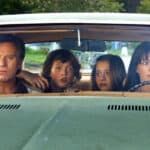
At the heart of this whirlwind of survival is a family navigating unimaginable peril. Anne Hathaway and Ewan McGregor anchor the story as parents attempting to manage panic, while Denise struggles with the mundane frustrations of everyday life colliding with extinction. The film shines in depicting the complex, often frayed dynamics of family bonds when they are most tested.
The chemistry between the parents is perhaps the greatest strength of the movie. Watching them grapple with chaos—and slowly, painstakingly, reconnect with one another amidst the impending doom—provides an emotional core that transcends the spectacle. It’s a beautiful reminder that even in the face of the apocalypse, human connection remains paramount.
The supporting cast brings incredible depth to this high-stakes scenario. Maisy Stella stars as the brilliant daughter, awakening to truths about herself, while Christian Convery portrays the son beginning to rebel against his passive father. These characters are wonderfully real; they aren’t idealized figures but flawed individuals grappling with massive, life-altering change.
Technically, the film is a triumph of execution. Despite its epic scale, the visual effects are absolutely flawless. The prehistoric creatures and the ravaged landscape are rendered with stunning beauty, avoiding the bloated spectacle often associated with larger-budget monster movies. The action is sharp and lean, treating the chaos with the grounded tension of films like Jaws—less running, more gripping survival.
Adding to the cinematic excellence is Michael Giacchino’s score, which perfectly complements the frantic pace and emotional turmoil. It manages to capture a grand, sweeping sense of epic danger while remaining intimate and emotionally resonant throughout the narrative.
Ultimately, The End of Oak Street is a masterclass in pacing and performance. It delivers pure, unadulterated entertainment, proving that when you combine exceptional direction, stellar casting, and high-stakes storytelling, you can create a cinematic experience that feels both thrilling and deeply human. It stands as one of the most enjoyable dinosaur movies since the original Jurassic Park.
Buy on Amazon
Credit